
 EN
EN


In a recent article about Flash therapy, we promised to tell you more about modern, effective and safe cancer treatments. One of them is proton therapy. In 2019, the first Proton Therapy Centre was opened in Spain at the Quironsalud Hospital. The three-year survival rate of women who have undergone proton therapy for breast cancer without metastases is 97.2%. For men with uncomplicated prostate cancer, this number rises to 99%. In Europe, there are only 23 facilities where this treatment is available. Learn more about the possibilities of this innovative method in the article below.
What is proton therapy?
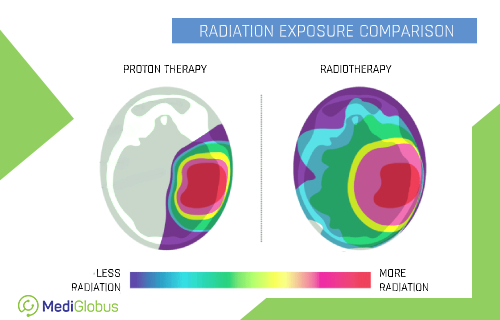
Today, the main methods of cancer treatment are surgery, chemotherapy, and radiotherapy. Doctors have achieved great results in improving these methods, but they have one significant drawback: along with the destruction of tumors, the healthy cells around the tumor get damaged. Up to 60% of radiation falls on them. Therefore, scientists have set themselves the task of finding new methods of cancer treatment that would be even more effective, but safer.
The solution is proton therapy. If during a traditional course of radiotherapy uses X-ray radiation, the new method instead employs positively charged particles – protons.
An apparatus called a cyclotron or synchrotron accelerates protons to 2/3 of the speed of light. In this state, protons begin to emit large amounts of energy and this allows them to penetrate through human tissue.
More than 175,000 people have already undergone proton therapy.
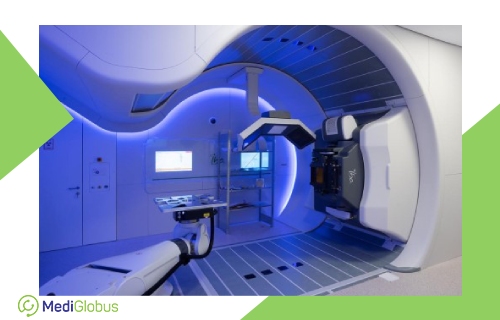
Although proton therapy still radioactive, unlike radiotherapy, it is more delicate. The degree of precision of the proton unit is 1 mm, compared to 2-5 mm in radiotherapy. This means that the healthy tissue around the tumor is less irradiated, but cancer decays more rapidly.
| Type of procedure: | proton therapy |
| Anesthetics: | not needed |
| Duration: | 15-30 minutes |
| Hospitalization: | not needed |
| Side effects: | fatigue and skin issues: redness, dryness, itchiness, flakiness, swelling. |
What kinds of cancer are treated with proton therapy?
 Brain and spine cancer;
Eye tumors;
Head and neck cancer;
Lung cancer;
Liver cancer;
Prostate cancer;
Bone and soft tissue cancer;
Benign tumors.
Not all cancers are currently treatable with proton therapy. Most often it is prescribed for non-metastasic tumors that are close to important organs.
Proton therapy proved itself especially useful in the treatment of children’s cancer. This is due to the minimal radiation exposure of healthy growing tissue. For example, the survival rate of children with brain ependymoma reaches 89%.
What are the benefits of proton therapy?
Reduced radiation exposure to healthy tissue;
Can be used on patients with kidney failure;
Safer for children;
Stronger reducing effect on cancer cells;
Fewer side effects such as nausea, dizziness, vomiting, reduced blood count;
Quicker and requires fewer sessions;
Better quality of life.
Among men with prostate cancer who underwent proton therapy, subsequent complications were observed in 1%. For prostatectomy, this figure is 28.6%.
How is proton therapy performed at Kiron Salud Hospital?
Beforehand, you will need to have a CT or MRI scan. This will allow doctors to determine the exact location of the tumor that needs to be irradiated.
The procedure is painless.
The medical team includes radiologists, oncologists, radiooncologists, dosimetrists, radiophysicians, and nurses. They calculate the required dosage of protons and the most effective way of administration.
Quironsalud Madrid uses Proteus One device. It has a high-precision tumor scanning technology. The design allows the ray to spin around the patient by 220°, irradiating the malignancy at different angles.
It is very important for the patient to remains immobile during treatment. For people with certain types of cancer, such as head and neck tumors, it can be difficult. For this reason, specially designed medical “masks” fix the position of the body during treatment. To reduce the patient’s anxiety, the process can be accompanied by a soothing video with atmospheric lighting and images of nature.
A team of doctors marks the boundaries of the tumor on the patient’s body so as not to damage the healthy tissue. A similar procedure is performed during conventional radiotherapy.
The number of sessions and their duration depend on the type and size of the tumor. Usually, 1-5 treatments are enough. Sometimes their duration may differ from one another: for example, on one day the doctor will irradiate the main tumor tissues, and on another day – nearby lymph nodes. As a rule, the fewer sessions are held, the more proton power is used. If proton therapy is limited to a single intervention, this is called radiosurgery.
The number and severity of side effects are less than with other treatments. At the same time, they may be present, especially if the patient is also undergoing chemotherapy. This problem can be solved by the nursing staff and the oncologist treating the patient.
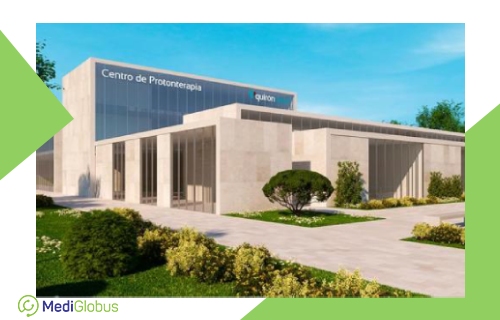
What are the features of the Quironsalud Proton Therapy Center in Spain?
The new Proton Therapy Center can accommodate 400 patients per year. In the near future, the hospital plans to double this number to 800 patients.
Proteus One at the Proton Therapy Center is the most advanced in its lineup. Its system is optimized for use in the treatment of a wide variety of cancers. This model uses energy-efficient cryogenic technologies. With time, it will be updated with new technologies that are now in development, specifically, and also includes improvements. with the addition of new features that are already in the research phase. These include rotation therapy and ultra-high intensity Flash radiation.
In addition, the Proton Therapy Center in Spain has an advantage for late-stage cancer patients from European and Asian countries. For people in these states, flights can sometimes be dangerous. Therefore, they will be able to reach the hospital by ground, without putting their health at unnecessary risk.
Proton therapy is a good alternative to radiation therapy, for example, for people with kidney failure or children. To register for treatment at the Quironsalud Madrid Proton Center Madrid, leave your application on the Mediglobus website and our coordinators will contact you.


